Blog

The Consolidation of the Veterinary Industry

Comments Off on The Consolidation of the Veterinary Industry

As the veterinary industry faces increasing levels of consolidation, it’s important to be aware of ownership of practices, as it can factor in to decisions about job applications. Some ‘independently owned’ practices are starting to promote this as an attractive option to job applicants, and new graduates are faced with a barrage of promotion from the major consolidators, who are able to offer attractive graduate training packages.

picture of australian and new zealand veterinary company logos

So, who are the major players?

Around 60% of veterinary practices in the U.K. are owned by six large consolidators, according to the CMA (the UK Competition and Markets Authority). The CMA has identified six large corporate groups (CVS, IVC Evidensia, Linnaeus, Medivet, Pets at Home, VetPartners) owning veterinary practices, including three that are owned by private equity firms.  After an initial review in September 2023, The CMA has reached a provisional decision to open a formal market investigation.

In the United States, about 30% of general practices and 75% to 80% of specialty practices are owned by consolidators, together accounting for at least 50% of industrywide revenue, by the reckoning of Chicago-based Brakke Consulting.

Levels of ownership concentration in Australia are lower, though by how much is unclear. According to data compiled by IBISWorld in 2023, VetPartners controls some five per cent of the Australian veterinary industry compared with Greencross, which has a 6.1 per cent share. The remaining 88.9 per cent is split among the remaining operators, many of whom are single-practice businesses. Australian consolidators have also acquired veterinary education facilities, pet crematoria, pet stores, and pathology businesses.

Some of the major Australian consolidators at the moment are:

  • Vetpartners –  acquired by Swedish private equity firm EQT (BPEA Private Equity Fund VIII) in 2023. Vetpartners practices are individually branded, but also incorporate some GP groups such as Vetwest and AdelaideVet, and a growing ream of referral centres including Southpaws, Brisbane Veterinary Specialist Centre, North Shore Veterinary Specialist Centre, Sydney Veterinary Emergency & Specialists, Peninsula Vet Care, and Perth Veterinary Specialists.
  • Greencross – acquired by US private equity firm TPG Capital (55%) in 2019. A 45% stake is owned by AustralianSuper and HOOP. There has been some interest in the group from Wesfarmers. GP clinics are branded Greencross, and there’s a network of Animal Emergency Centres, and also the Animal Referral Hospital group. Greencross also owns Petbarn, Animates, City Farmers and Habitat Pet Supplies.
  • Apiam Animal Health Limited, including Furlife Vet  companion animal clinics – ASX listed public company. With 80 clinics, Apiam is touted to be an attractive target for a buyout.
  • Vets Central – Pemba Capital Partners, Australian private equity firm (2021). Over 45 clinics according to the Pemba Capital Partners website. Pemba Capital Partners also has an interest in Queensland Veterinary Specialists, and VSA in New Zealand (Veterinary Specialists Aoteara).
  • CVS – CVS Group plc – UK listed public company currently expanding their consolidation of clinics in Australia, currently standing at around 28.
  • Petstock – Petspiration Group. 55% owned by Woolworths since the end of 2023
  • OurVet – PetO –  Australian owned private company. In 2024 PetO has taken over the practices divested by the Petspiration Group following the Woolworths deal (41 stores and 25 co-located vet clinics, branded Best Friends, Our Vet, My Pet Warehouse and Pet City), to add to a handful of clinics in Sydney.
  • Animal Emergency Australia, AES – Independent Employee Owned. Practices in 6 states.
  • Small Animal Specialist Hospital, SASH – Independent Vet Owned, private equity company has a minority stake

So how about New Zealand? Vet Clubs are being corporatized and clinics are also being consolidated, although it may not be as immediately obvious.

  • Vetpartners – owned around 50 clinics in NZ in 2023. Including Pet Doctors (most now de-branded). Foreign owned – acquired by Swedish private equity firm EQT (BPEA Private Equity Fund VIII) in 2023
  • Vetora – Vet Club
  • Vetlife Animal Health Partners – vet club/private company
  • VetEnt – Veterinary Enterprises Group Limited, Petfirst – private company
  • Anexa Veterinary Services – Anexa FVC – private company

The Kookaburra Vet Employment Salary Survey in 2022 highlighted some differences between corporate and non-corporate practices, one of which was the ‘happiness’ scores (243 responses).

It’s to be hoped that as levels of consolidation increase, these companies take the crisis in veterinary mental health seriously, and implement measures to improve support and working conditions for all their employees.

bar chart showing survery results - comparison of corporat/non-corporate practices and happiness

Author:
Wendy Nathan
Kookaburra Veterinary Employment

This information includes the views and opinions of Kookaburra Veterinary Employment and is of a general nature only. Factual information is believed to be correct at the time of writing, however, should not be relied upon and any person should confirm details with the relevant authorities and through their own research prior to acting on any of the suggestions in this article.

14/10/2024 |

2019 Salary Survey Results – Part 3 – On Call & Salary Extras

0

Kookaburra_Logo_stacked

1.     On Call / After Hours Payments

In the 2017 Kookaburra Salary Survey, respondents said that they would be interested to know how vets were being paid or compensated for on call work / after hours duties, and for being ‘on call’.

To download this Report as a printable pdf please click here https://www.vetsuppliersdirectory.com.au/wp-content/uploads/2019/09/Salary-Survey-2019-part-3-OOH-and-Extras.pdf

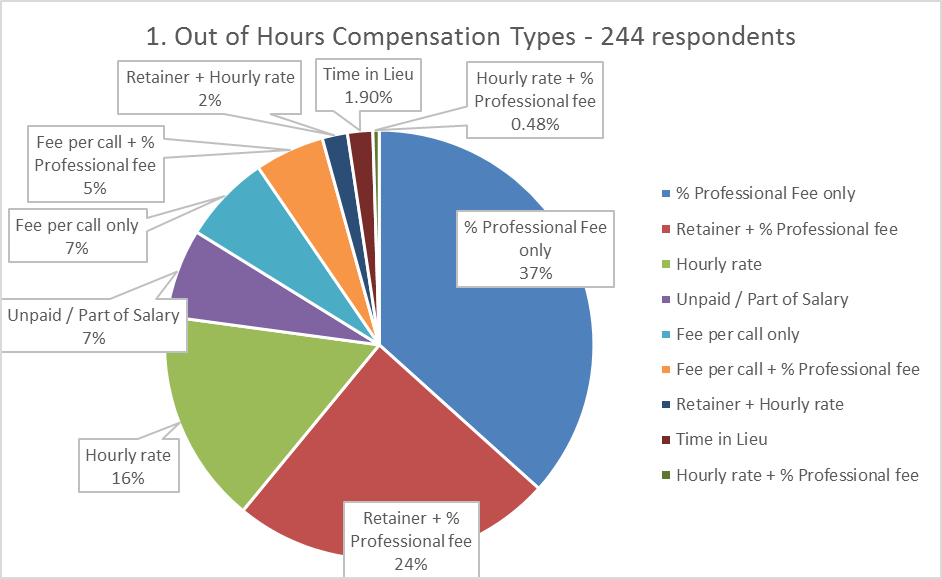
Out of Hours compensation types

% Professional Fees

69 % of respondents who told us what percentage of professional fees for after hour work they received (127 vets) got 50%. 10% of respondents got 100%. The rest varied from 10% through to 90%. There was a range of how this was calculated – some commented that this was not including GST. Others had a sliding scale depending on the type of service eg.

  • 46% surgery/consult/bandaging, 23% anaesthetics, fluids.
  • 75% consult fee, 100% procedure costs, 0% medications.
  • 100% of professional fee. This includes consult/call out fee and surgery fee.  Does not include radiology, anaesthesia, fluid therapy, hospitalisation.
  • 50 % of exam fee and professional fee only. No other percentage for professional fees- eg xrays fluids etc
  • 50% of professional fees (consult, X-ray, surgery, hospitalisation)

Only one person commented that they didn’t get paid until the client had paid.

Retainer

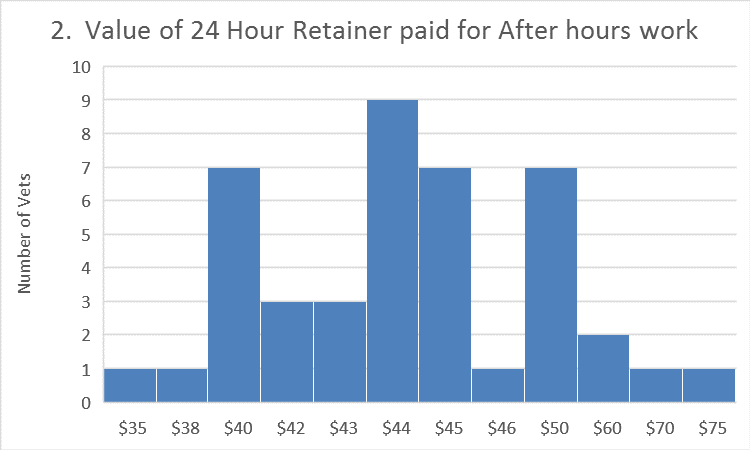
Retainer value

The value of a Retainer paid for after hours work varied considerably. Some respondents commented that they ‘lost’ the retainer once they attended a call, if they were receiving additional payment or a % of fees for the call-out. The Award allowance is currently $43.64 for each 24 hour period on call.

Hourly Rate

Some vets received an hourly rate for out of hours work – possibly considering this work as ‘overtime’. The Award does actually now include guidelines for paying overtime, but it’s unclear when these rates should be applied and what the difference between out of hours calls and overtime is. Examples of comments included:

  • 20% loading;
  • 30% loading;
  • 15% loading on base hourly rate for overnight, Friday nights. 1.5x on Saturday and Sunday. 2x on public holidays.
  • Double time
  • ‘same rate even if after hours’
  • Government – ‘ after hours / overtime pays 1.5 -2x normal Rate’

Fee Per Call

12% of respondents received a fee per call-out. This probably varies according to the after hours consultation fee set by the practice.

16 vets gave an indication of the fee they received, and it varied from $50 to $500.

($50 ,  $60 ,  $66 ,  $100 ,  $120 ,  $125 ,  $130 ,  $140 ,  $146 ,  $150 ,  $181 ,  $185 ,  $200 ,  $215 ,  $375 ,  $500 )

Unpaid / Part of Salary

7% of respondents (14 vets) were unpaid for after hours work, or had no additional compensation because it was considered ‘part of their salary’ , ‘expected as part of the job’, ‘reasonable unpaid overtime’. We didn’t collect information about the amount of after hours work performed by these vets.

2.     Salary Package Extras

We asked what kind of extras do vets receive in their salary package – respondents could choose multiple options from a preset list, and could also add their own comments. 452 vets responded.

Salary Package Extras2

There was no statistical difference between the extras received by vets working in corporate practices, and vets working in non-corporate practices, apart from Vehicle or vehicle costs – only 11.54% of respondents working in corporate practices received vehicle benefits compared to 24.07 % of respondents working in non-corporate practices.

When comparing vets classified as Full Time compared to Part Time, vets working in a full time vacancy were more likely to receive Board registration, AVA membership, and Vehicle costs.

Female Vets were more likely to receive Parental leave (11.11%) compared to Male Vets (5.08%)

We asked for extra information, and for information about any other types of benefits received, and this included the following:

  • Some vets receive a monetary allowance per year, to be spent on CE or other appropriate bills, ranging from $1000 to $2000 per year
  • Massage/acupuncture
  • VIN membership – this was commonly mentioned
  • CVE membership
  • AVA interest group memberships (ASAVA, EVA etc )
  • VDA membership
  • VECCS membership (Vet Emergency & Critical Care Society), Vetstream,
  • Beer
  • Christmas bonus
  • Extra Superannuation (above 9.5%) and option for salary sacrifice
  • Mobile phone or phone allowance
  • Extra holiday (in addition to 4 weeks standard leave)
  • Parking discount, Tollway tag
  • Pet Insurance, pet health care plan
  • Clothing allowance
  • Insurances – Income Protection, Professional Indemnity,
  • Radiation License
  • Rostered days off
  • Sponsored Visa

© Copyright Kookaburra Veterinary Employment

2nd September 2019

Logo

04/09/2019 |

Health Considerations for Overseas Vets working in Australia

Comments Off on Health Considerations for Overseas Vets working in Australia

Q fever

Q fever vaccination is recommended for all people who are working in, or intend to work in the veterinary field.
Q fever is caused by Coxiella burnetii, is a serious zoonotic disease in humans with a worldwide distribution. Many species of animals (commonly cattle, sheep, goats but also cats and dogs) are capable of transmitting C. burnetii, and consequently all veterinary staff are potentially at risk. Australia is the only country to have a licensed Q fever vaccine (QVax). Almost all, if not all, Australian veterinary graduates are vaccinated but overseas graduates, veterinary nurses and kennel staff should not be overlooked. The vaccine has been used in Australia for many years however still there are over 600 notifications across Australia annually. For more information visit http://www.health.nsw.gov.au/Infectious/factsheets/Pages/q-fever-veterinary-staff.aspx

Hendra

Overseas Vets working with horses in Australia should be aware of Hendra virus. Hendra virus infection in people can be fatal. http://www.health.nsw.gov.au/Infectious/factsheets/Pages/hendra_virus.aspx

Australian Bat Lyssavirus

ABLV infection can occur after being scratched or bitten by bats in Australia. Only people who have been vaccinated against rabies should handle bats or flying foxes. For more information see http://www.health.nsw.gov.au/infectious/factsheets/pages/rabies-australian-bat-lyssavirus-infection.aspx

Author:

Wendy Nathan
Kookaburra Veterinary Employment
November 2017

This information includes the views and opinions of Kookaburra Veterinary Employment and is of a general nature only. Factual information is believed to be correct at the time of writing, however, should not be relied upon and any person should confirm details with the relevant authorities and through their own research prior to acting on any of the suggestions in this article.
28/11/2017 |

Salary Survey 2016

Comments Off on Salary Survey 2016

Kookaburra Vet Employment Salary Survey

Some of the most common questions that we get asked at Kookaburra Vets relate to Salary levels. We’d appreciate if you would help us collect some up to date information by completing this short anonymous survey, if you are a veterinarian currently working in Australia.

Complete Salary Survey Now

The results will be available on request from Kookaburra Vets, however, if you wish to provide us with your email address at the end of the survey, we will also email you a copy. Thank you for your help.

10/03/2016 |

Employing Overseas Vets & Vet Nurses – September 2023 Update

Comments Off on Employing Overseas Vets & Vet Nurses – September 2023 Update

Visa picture

Information below has been sourced from the Department of Home Affairs website www.homeaffairs.gov.au in September 2023.

Skilled Occupation List

The Priority Migration Skilled Occupation List (PMSOL) was temporary and existed while Australia recovered from the COVID pandemic.

It has now been replaced by the Skilled Occupation List. This combined list comprises occupations on

  • the Medium and Long-term Strategic Skills List (MLTSSL),
  • the Short-term Skilled Occupation List (STSOL),
  • the Regional Occupation List (ROL)
  • or the Regional Sponsored Migration Scheme (RSMS) ROL List

The following visas, which may be of interest to vets and vet nurses, are available to individuals qualified to work in the eligible skilled occupations. Please see www.homeaffairs.gov.au for details of additional visas.

  • Temporary Skill Shortage (TSS) visa (subclass 482)​
    • See extra information below
  • Skilled Employer Sponsored Regional (Provisional) visa (subclass 494)
    • Regional areas – all areas of Australia except for Sydney, Melbourne and Brisbane
    • Length of stay – up to 5 years
    • Under 45 years of age (some exemptions exist)
    • 3 years’ experience
  • Employer Nomination Scheme (ENS) visa (subclass 186)​
    • This is a permanent visa
  • Regional Sponsored Migration Scheme (RSMS) visa (subclass 187)
    • This is a permanent visa, for workers transitioning from a 457 or 482 visa & continuing to work for their sponsoring employer

Employers – Standard Business Sponsor

Before an employer is able to nominate a vet to sponsor in the TSS 482 or Regional 494 visa categories, they must be, or have applied to become a standard business sponsor. Once approved, this status lasts for 5 years.  ( Further eligibility requirements exist in order to be an Accredited sponsor, including NOT being a sole trader or partnership ). As of 6th September 2023 this is the direct link for information on the procedure:

https://immi.homeaffairs.gov.au/visas/employing-and-sponsoring-someone/sponsoring-workers/becoming-a-sponsor/standard-business-sponsor#Overview

Temporary Skill Shortage visa (subclass 482)

The Temporary Skill Shortage (TSS) visa (subclass 482) replaced the old 457 visa in March 2018.

TSS visa holders can work in Australia in their nominated occupation for their approved sponsor under one of three streams:

Short-term stream

  • Length of stay – up to 2 years
  • Vet Nurses are currently on the Short term Skilled Occupation list (STSOL)
  • Requirements for eligibility include English language requirements, skills assessments (by VETASSESS for VNs), nomination by an employer, health and character requirements.
  • Must have worked in the nominated occupation, or a related field, for at least two years
  • There is no age requirement
  • The current link for skills assessment for migration for Vet Nurses is https://www.vetassess.com.au/skills-assessment-for-migration/professional-occupations/application-process

Medium-term stream

  • Length of stay – up to 4 years
  • Vets are currently on the Medium term Skilled Occupation list (MLTSSL)
  • Requirements for eligibility include English language requirements, skills assessments (by AVBC for Vets), nomination by an employer, health and character requirements.
  • Must have worked in the nominated occupation, or a related field, for at least two years
  • There is no age requirement
  • The current link for skills assessment for migration is https://avbc.asn.au/for-veterinarians/skills-assessment-for-migration/ You can only apply for a skills assessment once you hold full registration with an Australian Veterinary Registration Board.

Labour Agreement stream

  • This stream is available if your employer wishes to sponsor you (as an overseas worker) and has entered into a labour agreement with the Department

Application for the Temporary Skill Shortage (TSS) visa (subclass 482) involves a three-step process:

Step 1: a sponsorship application by the employer

Step 2: a nomination application for a skilled position by the employer

Step 3: a visa application by the proposed employee

Labour Market Testing requirement –  Subclass 482 (TSS) and Subclass 494 (Regional)

For a nomination to be approved, the Department must be satisfied that a suitable qualified and experienced Australian worker is not available to fill the nominated position.

For most nominations, advertising must be done within the 4 months immediately before lodging a nomination application. Advertising must meet all of the below (further requirements may apply – please see www.homeaffairs.gov.au for up to date information – the direct link is currently https://immi.homeaffairs.gov.au/visas/employing-and-sponsoring-someone/sponsoring-workers/nominating-a-position/labour-market-testing  as of September 2023):

  • the nominated position has been advertised in Australia
  • the advertisement was in English and included the following information:
    • the title, or a description, of the position
    • the name of the approved sponsor or the name of the recruitment agency being used by the sponsor and
    • the annual earnings for the position ( unless the annual earnings will be greater than $96,400 ) It is acceptable to publish a salary range.
  • at least two advertisements were published:
    • on a national recruitment website. Note: a general classifieds website is not an acceptable method
    • in national print media
    • on national radio or
    • if the sponsor is accredited – on the business’ website.
    • advertisements, including on websites, are expected to have run for at least 4 weeks

Kookaburra Veterinary Employment can supply a statement on request with information regarding your job advert, the period that it was listed, and the total cost of advertising.

Additional Requirements for nominations lodged on or after 1 October 2020

In September 2020, the Australian Government introduced new labour market testing measures for employer sponsored applications. 

In addition to the 2 advertisements mentioned above:

  • the nominated position must be advertised on the Government’s jobactive website ( https://jobactive.gov.au/ )
  • the jobactive advertisement must have included all of the information required to be included in the other 2 advertisements mentioned above
  • jobactive advertisements are expected to have run for at least 4 weeks
  • applications or expressions of interest for the advertised position must have been accepted for at least 4 weeks

Note: advertising may have been undertaken by a third party if authorised to do so by the sponsor (for example, an associated entity or a contracted party, such as a recruitment agency) – there is no requirement that the sponsor placed the advertisement themselves

Evidence of a total of 3 advertisements, including an advertisement published on the Government’s jobactive website, must be provided at the time the nomination is lodged.

Meeting TSMIT requirements

Both the Annual Market Salary Rate (AMSR) for the nominated occupation and the guaranteed annual earnings that will be paid to the nominated overseas worker, excluding any non-monetary benefits (for example, accommodation or car provided to them as part of their salary package), must not be less than the TSMIT (Temporary Skilled Migration Income Threshold).

TSMIT is currently set as AUD$70,000 for applications lodged on and after 1 July 2023, as specified in the relevant legislative instrument. For applications lodged before 1 July 2023, it was AUD$53,900.

The requirements and process for visa application can be very complicated and there are more conditions than are listed in this article – you can find more information at www.homeaffairs.gov.au

Migration Agents

If you are considering engaging a migration agent, you should ensure they are registered with the Office of the Migration Agents Registration Authority (OMARA). This registration demonstrates they have sufficient expertise and are a fit and proper person to provide immigration assistance. The OMARA registrar can be found at portal.mara.gov.au/search-the-register-of-migration-agents/. It is recommended that you look up a migration agent to ensure they are on the registrar before engaging their services.

Author:

Wendy Nathan
Kookaburra Veterinary Employment

This information includes the views and opinions of Kookaburra Veterinary Employment and is of a general nature only. Factual information is believed to be correct at the time of writing, however, should not be relied upon and any person should confirm details with the relevant authorities and through their own research prior to acting on any of the suggestions in this article.
06/09/2023 |
© Vet Suppliers Directory 2019. Vantage Theme – Powered by WordPress.
Skip to toolbar