
Veterinary Weighing Scales
Comments Off on Veterinary Weighing Scales Sunbeam TRU-TEST AG500
- In good working order
Price $200
Located on the Gold Coast.
Contact Mermaid Waters Vet Surgery: mwvs4218@gmail.com
Phone: 0400 105 686
 Sunbeam TRU-TEST AG500
Price $200
Located on the Gold Coast.
Contact Mermaid Waters Vet Surgery: mwvs4218@gmail.com
Phone: 0400 105 686
We provide consultations to veterinarians caring for animals of any species (dogs, cats, horses, sheep, rabbits, cattle etc), with any type of cancer. We will review case information in depth and provide a complete written report with recommendations and responses to specific questions.

With our extensive knowledge and expertise in the field, we are committed to helping you improve the quality of life for your patients and support their families throughout the treatment process.
Contact our Team
EMAIL: voc@vetoncologyconsults.com | WEB: www.vetoncologyconsults.com | PH: 0459 952 124
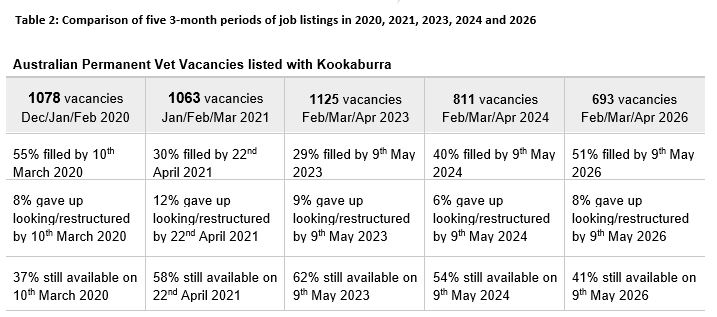
Job data collected and tracked by Kookaburra Veterinary Employment for permanent vacancies in Australia reveals an easing of the shortage of veterinarians relative to the numbers of vacancies available, over the last 2 years. The hardest year to fill a vet vacancy was 2023, and since then, clinics have gradually been receiving more applicants and filling their vacancies in less time.
The bad news for vets graduating from university this year is that less clinics will now consider training a new grad. One conclusion that could be drawn from this is that many clinics don’t see value in employing a new graduate or perceive new grads as a burden on their practice, and they will try to avoid it if there are vets with some experience available. Alternatively, it’s possible that practices are already weighted heavily towards less experienced associates.
Kookaburra Vet Employment also has a limited amount of data on veterinary nurse and support staff vacancies. Anecdotal reports from clinics have suggested that it is increasingly difficult to source veterinary nursing staff this year, and this is supported by the increasing number of vacancies being advertised.
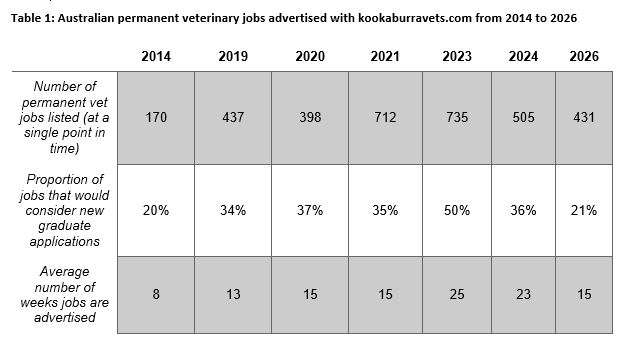
As of 26th August 2026 there were 431 open vet vacancies advertised with Kookaburra. 78 jobs had been continuously advertised for over 8 months (18% ).
In the 3 months February, March, April 2026, 693 jobs were advertised.
On 30th April 2023, 52 clinics had been advertising continuously for longer than 2 years without filling their vacancy, but by 26th August 2026, only 12 clinics had been continuously advertising for longer than 2 years without apparently filling their vacancy.
In March 2020 we had 236 vet nurse jobs listed.
In April 2021 we had 337 vet nurse jobs listed.
May 9th 2023 we had 316 vet nurse jobs listed.
June 26th 2024 we had 236 vet nurse jobs listed.
August 26th 2026 we had 344 vet nurse jobs listed
Author:
Wendy Nathan
Kookaburra Veterinary Employment
This information includes the views and opinions of Kookaburra Veterinary Employment and is of a general nature only. Factual information is believed to be correct at the time of writing, however, should not be relied upon and any person should confirm details with the relevant authorities and through their own research prior to acting on any of the suggestions in this article.
 Many veterinary practices in Australia are feeling the pinch of the manpower shortage, putting vets under more pressure and contributing to dissatisfaction with work life balance and mental health problems.
So, maybe you need a Vet Tech at your clinic.
In Australia, the current Australian national qualification for vet nursing is Certificate IV in Veterinary Nursing, which takes from 18 months to 2 years to complete. The Diploma in Veterinary Nursing is then an additional qualification following on from the Cert IV, for 12 months, in 3 different streams, General Practice, Surgical, and Emergency & Critical Care
Veterinary Technology is a Bachelor’s degree taking 3 years (full time), which can incorporate and extend the Cert IV in Vet Nursing. It’s offered by Charles Sturt University, The University of Queensland, and the University of Adelaide, (and by Massey University in New Zealand, however, this isn’t yet included in the list of Vet Tech degrees eligible for the new Australian Veterinary Nurse and Technician (AVNAT) Registration Scheme)
Information provided by CSU and the University of Queensland about their Veterinary Technology degrees suggest there is more development of skills in critical thinking and problem solving, preparation for supervisory and management roles, as well as knowledge of a wider range of animal species and knowledge and professional skills in animal management, technology and welfare that can be used beyond the clinical setting. However, extended clinical support procedures are also taught. The first cohort from CSU graduated at the end of 2018.
The University of Adelaide degree will commence with its first intake in 2020. Information provided by the University suggests the program will have a strong practical component with students performing almost 500 hours of hands-on clinical experience in a veterinary workplace and in the University’s on-site clinics and diagnostic laboratories, and could equip students with specialist expertise in one or more areas including small animals; anaesthesia; imaging; equine; farming; or practice management.
Some clinics, emergency and critical care hospitals, and specialist centres in Australia are already using a very effective tiered system of support staff, from kennel hands and specific customer support staff/receptionists, through trainee veterinary nurses, veterinary nurses, diploma qualified VNs, degree qualified veterinary technicians, and practice managers. This means that Veterinary Surgeons gain the time to do the work that only they are qualified for.
This tiered system can also provide a structured career path for support staff, which can improve job satisfaction. Whilst attention is finally becoming focussed on the challenges for vets surrounding mental health awareness, life balance, burnout, compassion fatigue, job satisfaction, and decisions to quit the profession, we mustn’t forget there are similar challenges for our support staff.
So, rather than trying to employ another Vet in a very tight market, could this be a solution for some clinics?
References:
Charles Sturt University
https://futurestudents.csu.edu.au/courses/animal-vet-sciences/bachelor-veterinary-technology
University of Queensland
https://future-students.uq.edu.au/study/program/Bachelor-of-Veterinary-Technology-2387
University of Adelaide
https://www.adelaide.edu.au/degree-finder/bvt_bvettech.html
Massey University
http://www.massey.ac.nz/massey/learning/programme-course/programme.cfm?prog_id=93432
Veterinary Nurses Council of Australia
https://www.vnca.asn.au/membership/recognised-qualifications/
This information includes the views and opinions of Kookaburra Veterinary Employment and is of a general nature only. Factual information is believed to be correct at the time of writing, however, should not be relied upon and any person should confirm details with the relevant authorities and through their own research prior to acting on any of the suggestions in this article.

So you’ve been searching through the abundance of job ads listed on Kookaburra’s site or App and have found yourself a dream job – Yay you!
Now what?
How do you convince the Recruiter that you are the person they have been looking for… the one they NEED?
Let’s look at ways to impress and not depress them. Resumes are not known to be exciting discussion points, but they are necessary at some point.
Whether you’re a graduate looking for first employment, someone moving to a new location, seeking a career change or making a career progression, you will need to update your resume, and just like everything, the standards and formats change, so it’s important to be current and move with the times.
Resume or CV? We mostly use the word Resume here in Australia, and for the purpose of this article we’ll use Resume.
It’s beneficial to view your Resume as the clever marketing tool of You.
This article mainly concentrates on the Resume, but at the end I’ll also touch on the very important ‘Cover Letter’ which can have an impactful way of creating a first impression.
Regardless of whether you are applying with a small independent or a large company, unfortunately if your resume or cover letter doesn’t make the cut in comparison to others, and instead bores or confuses the reader into a micro-sleep – you may not get to an interview.
The top third of your resume is where you have a brief moment to captivate & intrigue the reader with a Profile section.
This is a summary section where you can use a few sentences to highlight your skills and experience & achievements. Also cater your profile to address the qualities or skills being required in the application.
Eg: “Qualified Cert IV Vet Nurse with 15 years experience working with small animals, supporting vets in surgery in procedures such as IV catheter & blood collection. Friendly and understanding with animals and humans alike – owner of 2 dogs & 3 cats! Enjoys a dynamic fast paced workplace and implementing systems and changes to streamline an effective and productive clinic. More than advanced in the operation of Ezyvet & Vet Radar. Looking for further career progression in a community minded & progressive clinic. “
Contact Details, Name, Email & Mobile.
Spend some time on this. It’s a super important letter of introduction which will introduce your resume. Often ‘optional’ , it is recommended to include a Cover Letter..
It’s your chance to grab the recruiter’s attention with your personality and story. Speak from your heart directly to the recruiter to show how perfectly you fit the role.
One of the big reveals that recruiters are looking for is… your WHY. In this letter address:
Good luck with your applications and remember to ask after your submissions if there is any feedback on your application format or gaps in the information delivered so you can improve – they may give you feedback.
Author:
Rachael MacLaren
Kookaburra Veterinary Employment
This information includes the views and opinions of Kookaburra Veterinary Employment and is of a general nature only. Factual information is believed to be correct at the time of writing, however, should not be relied upon and any person should confirm details with the relevant authorities and through their own research prior to acting on any of the suggestions in this article.