

Will AI Save the Veterinary Profession?
Comments Off on Will AI Save the Veterinary Profession?Now that even free AI Assistants and conversational platforms have progressed to be able to request more information and even make un-solicited suggestions in a very user-friendly way, they are capable of offering a fantastic troubleshooting service. Recently, I was configuring a new computer, including migrating data from an old Apple iMac. I encountered a major “failure to work as expected” problem that would normally have seen me, following a certain amount of hair-pulling, need to sheepishly rock up to the local Apple Store for some tech support. Seeing as said ‘local Apple Store’ is actually located 400km away, instead, I asked ChatGPT to help investigate the problem.
Together, with ChatGPT as the brains, and with me as the technician, we performed a number of tests, formulated a diagnostic differential list, and finally worked through them logically to find the offending corrupted database, and then fix it, all without destroying any previously working parts of the computer (always a risk … “first do no harm” ⚕ ).
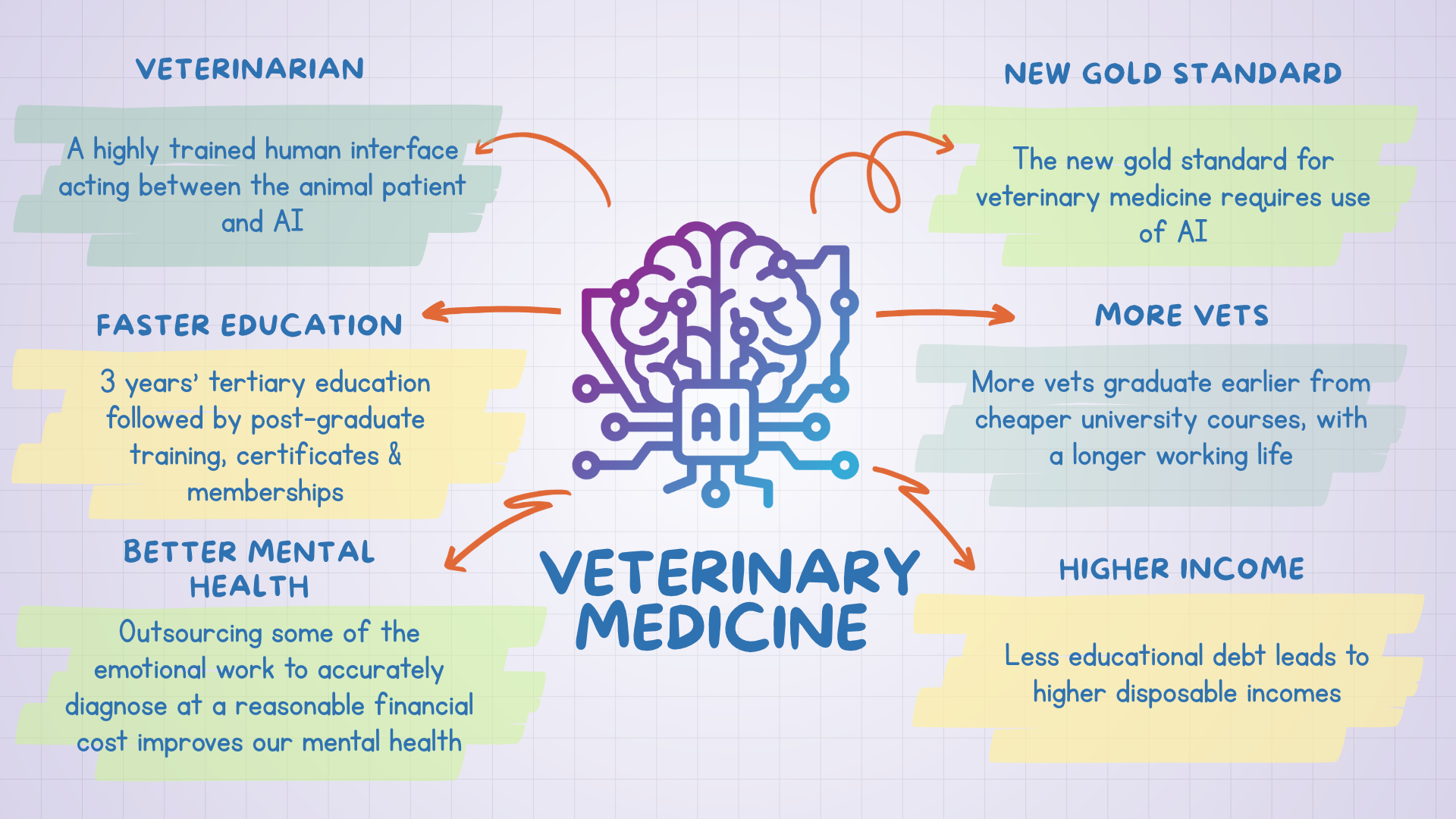
This experience set me off on the path of pondering the future of Veterinary Professionals. How long could it be before we are able to graduate Veterinarians after, say, only 3 years of Tertiary Education. No longer will vets have to learn the in-depth knowledge required to make the leap from history taking and clinical examination to differential diagnoses and treatment plan. Skilled human hands will be needed ‘on the ground’ to gather information, and relay it to the AI Veterinary Brain, await further instruction, and then proceed with further testing, or treatment. With respect to surgical technique, veterinarians currently graduate with very little practical experience, so this would still all be learnt post-graduation.
Who could resist taking advantage of the AI brain? Maybe the new Gold Standard for veterinary medicine will require the use of AI.
Passing some of the heavy responsibility carried by vets, who feel the emotional pressure to ensure a good outcome with an accurate diagnosis often at the lowest financial cost, to AI could help improve our mental health.
And what would this mean for the tertiary institutions currently teaching veterinary medicine? Shorter and cheaper courses could produce a higher throughput of veterinarians, all graduating at a younger age, with a correspondingly longer working life, and starting out with much less debt.
As AI is refined, and becomes able to run more efficiently, imagine clinic-portable databanks able to collate and analyse local patterns, receiving the input of thousands of clinical cases, and able to produce an encyclopedia of evidence-based medicine.
At this point of writing this article, having learnt that a punchy conclusion is a vital part of an essay courtesy of my youngest son who has just sat his HSC English, I went back to ChatGPT to ask if it would like to write a concluding paragraph.
So, from the horse’s mouth:
ChatGPT (OpenAI):
“Perhaps, then, the question is not whether AI will replace veterinarians, but what we will expect veterinarians to be able to do once AI becomes an integral part of veterinary medicine. The ability to memorise an enormous body of knowledge and recall it under pressure may become far less important than the ability to gather accurate information, recognise when something does not fit, question an AI-generated conclusion, communicate with owners, and use skilled hands to examine, treat and care for an animal. The veterinary profession may evolve from being the sole holder of medical knowledge to being the highly trained human interface between that knowledge, artificial intelligence, the patient and its owner. That could be an extraordinary opportunity: not to remove the veterinarian from the equation, but to remove some of the limitations imposed by being human. And perhaps the vets of the future won’t need to know less after all — they will simply need to know different things, and to know when to trust the machine, when to challenge it, and when to put it aside and trust their own judgement.”