Blog

Working as a Locum – Part 1

Comments Off on Working as a Locum – Part 1

To work as a locum, vets should have a minimum of 2 years’ experience, and preferably over 3 years for sole charge practices. Not only is locuming a great way to finance travel, it is also a good way to gain additional experience working with different people, in a wide variety of different conditions, and improve your veterinary skills.

photo of vetsIn major cities, although there are more clinics in a smaller geographical area, there is usually more competition for locum work, therefore to be assured of a constant supply of work, locums should be willing to travel – and you can miss out on amazing experiences if you don’t consider travelling to work in more rural and regional areas. Country jobs will usually supply accommodation and maybe a vehicle for work and private use, however, city practices very rarely supply either accommodation or a vehicle.

Locum vacancies can range from a single shift to 5 or 6 months’ work, and include full time and part time hours. Locums help cover for temporary staffing shortages, illness, periods of leave and holidays, and parental leave. Jobs can be advertised up to 4 months in advance, however, they can also be listed at very short notice (next day). On average, locum jobs listed with Kookaburra Vet Employment are to start within 1-2 months.

Work

Most clinics require a locum with a minimum of 2-3 years’ experience who doesn’t require direction for most clinical judgments, but who will ask for help if it’s required or if they get out of their depth. Surgical experience is necessary – you must be able to do at least routine surgery including desexings in a timely manner (ie. not take too long).

It can be important to stick to clinic protocols, within a perceived duty of care. Clinics may see a high proportion of particular types of cases – eg ticks; snake bite; poisonings – ask the regular vet before they go away if there is a clinic protocol or for any tips on these type of cases.

Record keeping is extremely important – the locum may move on, but the clinic owner or regular vet then has to continue with ongoing care. Make sure that your handwriting is legible, and you use any computerised system to keep comprehensive clinical notes. Locums should try to fit in with existing staff and not rock the boat!

Make sure that you stick to practice pricing – please don’t undercharge just because you perceive the practice prices to be excessive.

Try not to put things off until the regular vet gets back.

Conduct

Practices expect a locum to be honest, punctual, friendly, polite, and able to take direction if required without taking offence. Derogatory, sexist, and discriminatory behaviour and comments are absolutely not acceptable.

If a work vehicle, or a vehicle for private use is supplied, it should be kept clean on the inside (if not the outside!), and driven with due care and attention. Establish the protocol for paying for petrol before commencing work.

If accommodation is supplied, it should be left clean and tidy. Talk to the employer about any use of private items or groceries if you are staying in their own house BEFORE you use anything, and establish whether you are expected to replace any items used.

CVs and References:

You should be prepared to send your CV to clinics when you apply for a vacancy. It should contain up to date information and be accurate, particularly with up to date contact information for you including a mobile number preferably with a message bank. Include contact details for recent referees, and email addresses, particularly if your referees are overseas.

Contract

article-contract-signingdesigned-by-freepik-smallerAlthough practices and locums may not decide to formally enter into a contract, it is a good idea to set down terms of employment and working conditions in writing prior to the start of the locum period. Things to consider include:

  • Pay rate;
  • after hours remuneration;
  • days off;
  • overtime;
  • normal hours of work;
  • type of payment arrangement and when the vet is to be paid;
  • type of employment (casual employee, contractor);
  • Superannuation; GST;
  • Travel Costs;
  • Professional registration costs;
  • Responsibility for keys – for the clinic and for scheduled drugs
  • Accommodation and responsibilities of the locum with respect to the accommodation and use of facilities if applicable (eg phone, internet, food in the pantry);
  • provision of vehicle for work – and private use – and fuel costs;
  • any provision for short term cancellation of the locum period by either party.

This list is by no means exhaustive. Contact the AVA HR Hotline for more information – 1300 788977 or email avahrhotline@whr.com.au  (you need to be an AVA member (Australian Veterinary Association).

Author:

Wendy Nathan
Kookaburra Veterinary Employment

This information includes the views and opinions of Kookaburra Veterinary Employment and is of a general nature only. Factual information is believed to be correct at the time of writing, however, should not be relied upon and any person should confirm details with the relevant authorities and through their own research prior to acting on any of the suggestions in this article.

03/11/2021 |

“Writing a Good CV” for Veterinarians

Comments Off on “Writing a Good CV” for Veterinarians

How to write a CVA Résumé, or CV (Curriculum Vitae), is vitally important to make a good first impression, and secure an interview.

It should be:

  • Easy to read
  • Include all relevant information
  • Accurate

An employer wants to know your name and contact details, what level of experience and qualifications you have and what additional skills you can bring to the practice to make you a valuable employee.

How to lay out a CV

Your CV should be easy to read so that a potential employer can quickly find the information they are looking for.

  • Use clear headings
  • Line things up! – use tabs
  • Use bullet points or numbered lists
  • Use a standard format throughout your CV – make it match
  • When listing things in date order, put the most recent first
  • Use a clear font – don’t use a handwriting or ‘fun’ font
  • Don’t use a large font – 10 or 11 is fine
  • Optimum 2 to 3 pages long
  • Do a Spell Check and a Grammar Check!

You can use a Résumé Template to give you a hand, but make sure you delete any irrelevant information.

Major Headings

  1. Contact Information and Personal Details
  2. Qualifications/Education
  3. Skills / Personal Statement
  4. Previous Employment
  5. Undergraduate Work Experience
  6. Undergraduate or Non-Veterinary Employment
  7. Continuing Education
  8. Personal Interests
  9. References
  10. Additional Sections
  11. Photograph
  12. Once you’ve written your CV, DO A SPELL CHECK!

1.      Contact Information and Personal Details

Include your full name, address, contact telephone number and email address. If your Visa status or Nationality will have a bearing on your suitability for work (eg overseas qualified vets) you can include it here.

2.      Qualifications/Education

Don’t include too much detail. List the most recent first ( reverse date order). New grads can include school details but for vets qualified several years it isn’t necessary.

3.      Skills or Personal Statement

Use this section to list your skills and competencies, veterinary interests, and career aspirations. Sell yourself!

Why Should we hire You?

4.      Previous Veterinary Employment

List previous veterinary employment with the most recent first ( reverse date order). Make it easy to read and to see dates. If there are any dates where you were travelling for example, or took a ‘career break’ for any other reason, include those details too. Do elaborate (briefly) on your actual duties and any specific skills acquired.

If you have been graduated for a long time and worked at many clinics, only give additional details for the most recent.

If you have locumed for a while, you don’t need to list all your locum jobs – just give a brief summary.

5.      Undergraduate Work Experience

This only applies to new graduates, and is extremely important. List the most recent first. List the clinics that you have seen practice at, and for how long. Describe the clinic, and give a brief description of the skills that you learnt while there.

6.      Undergraduate or Non-Veterinary Employment

It’s only worth including this if you’re a new grad, or if the type of work you have done is particularly relevant to the veterinary jobs you are now applying for.

Writing a CV

7.      Continuing Education

This section is extremely important, and becoming more so as the various Vet Boards start to enforce a requirement to complete a set amount of continuing education each year. Put the most recent first.

8.      Personal Interests

Yes, this is important! Vets need to be well balanced individuals to cope with the stresses of their work life.

9.      References

If you have a written reference, attach it to your CV. Please include full contact details for your referees – nothing is more annoying than having to look them up!

It can be difficult for new graduates to get references, however, it is worth asking the practice principal where you have had most work experience to write you a reference, or be listed as a referee.

10.      Additional Sections

In addition to the basics, you may want to include more information. Put extra info between the Continuing Education, and Personal Interests sections. Examples could include professional memberships & subscriptions, and additional useful skills, including technical/computer skills, languages, community activities, volunteer experience, Awards received.

11.      Photograph

It’s a hard question, whether or not to include a photograph of yourself on your CV. Generally, if you’d like to include a photo, just use a regular passport style photo.

And Finally – DO ANOTHER SPELL CHECK!

You're Hired

Author:

Wendy Nathan
Kookaburra Veterinary Employment

This information includes the views and opinions of Kookaburra Veterinary Employment and is of a general nature only. Factual information is believed to be correct at the time of writing, however, should not be relied upon and any person should confirm details with the relevant authorities and through their own research prior to acting on any of the suggestions in this article.

09/08/2021 |

Ten Top Tips for Advertisers

Comments Off on Ten Top Tips for Advertisers
"Top Ten" image

There is a lot of competition between clinics to fill practice vacancies for vets and vet nurses at the moment. These are Paula’s Ten Top Tips to consider when advertising:

  1. Boost your extramural studies program: you may pick up a new graduate vet;
  2. Have a strong vet nurse team: boosting the role of your nurses makes your practice more attractive to potential applicants;
  3. Reply promptly to applicants: communicate in a timely manner;
  4. Sort out your social media: applicants are looking for practices with a strong online presence;
  5. Put your team online: pictures of your happy, sociable team can play a role in attracting applicants;
  6. Give everyone a lunch break: this will impact on your team’s work/life balance and outlook on their job;
  7. Undertake regular social activities: encourage your team to be socially engaged with each other and their community;
  8. Promote your location: applicants are looking for somewhere they can settle so provide them with reasons why for your area;
  9. Talk openly about the full benefits package: advertise your salary range on offer; and
  10. Pictures of equipment are to be avoided: this is unlikely to attract applicants as most practices use similar equipment.

My current rule of thumb is to take the emphasis in the ad off what you want from your new employee and instead put it on what you are offering.

Author:

Paula Strong
Kookaburra Veterinary Employment

This information includes the views and opinions of Kookaburra Veterinary Employment and is of a general nature only. Factual information is believed to be correct at the time of writing, however, should not be relied upon and any person should confirm details with the relevant authorities and through their own research prior to acting on any of the suggestions in this article.

08/12/2020 |

Locum Vet Checklist for Employers

Comments Off on Locum Vet Checklist for Employers

Employing a locum vet can happen in a rush – but there are several things that an Employer in Australia should check prior to the locum starting work. This article is based on the “10 Things to ask your Locum Vet” factsheet written by Kookaburra Veterinary Employment.

Stack of CVs1. Visa.

An overseas vet should have a valid work Visa. It is an offence to employ someone without a valid work visa, so it’s the employer’s responsibility to check. Most overseas vets should have their passport with them or be able to provide details about their visa. See www.border.gov.au for more information. You can now check to see if a worker has work rights in Australia at www.border.gov.au/Busi/Visa – you should ask for consent to check the worker’s visa details first.

2. Tax File Number.

If a vet is going to be working for you as an employee, you will need their Tax File Number. See www.ato.gov.au for more information

3. ABN.

If a vet says that they are self employed, they should provide you with their ABN – Australian Business Number. See www.ato.gov.au for more information, or consult your accountant for individual information about the best way for your practice to pay locums. Some locums are employed as casual employees, some locums are engaged as independent contractors. It’s likely that either way, the clinic will have to pay superannuation under the Superannuation Guarantee. There are Calculators online on the ATO website that help you work out whether your locum is an employee or a contractor, and in either case whether you should be paying superannuation for them. Keeping a record of your use of these calculators can support your decision if necessary.

4. CV and References.

Locum vets should be able to provide contact details for 1 or more recent veterinary referees. Clinics should make sure that any locums introduced to them have the required experience for a particular locum job. Kookaburra Veterinary Employment can provide CVs for all locums listed on their register – these CVs are provided by the locum vets to Kookaburra, and Kookaburra doesn’t provide any warranty as to the accuracy of any CV. We recommend that clinics take up one or more references for a locum prior to booking them for any work.

5. Vet Board Registration.

Following mutual recognition implementation in many States, you can now search for a particular registered veterinarian on the Australasian Veterinary Boards Council website at www.avbc.asn.au and find the State that they have primary registration with. It is good practice for vets to use their board registration number after their signature when signing certificates etc. See www.avbc.asn.au for information about registration of overseas qualified veterinarians.

NB: In Western Australia there is the requirement for a veterinary surgeon who appoints a locum to give written notice to the WA Vet Surgeons’ Board of the name of the locum, and the period of the appointment before, or as soon as possible, after the appointment commences.

6. Professional Indemnity Insurance.

The practice insurer may cover all vets working at the practice, or the Locum vet may have their own PII. It’s a good idea to make sure that all your locums and employees have adequate cover. In South Australia this is a requirement for all vets registering with the SA Vet Board.

7. Workers Compensation.

The locum vet may or may not be covered by the Practice workers compensation scheme – check with your Insurer.

8. Medical Insurance.

The locum vet may have their own medical insurance or, if from overseas, may be covered by a reciprocal agreement with Medicare.

9. Other Professional Registration.

For example, some States require vets to be licensed to use Radiation equipment.   Vets may also need to be registered or licensed to perform other duties such as microchipping, preg testing, certification for export etc.

10. Contract

Although practices and locums may not decide to formally enter into a contract, it could be a good idea to set down terms of employment and working conditions in writing prior to the start of the locum period. Things to consider include:

  • Pay rate;
  • after hours remuneration;
  • days off;Signing a Contract
  • overtime;
  • normal hours of work;
  • type of payment arrangement and when the vet is to be paid;
  • type of employment (casual employee, contractor);
  • Superannuation;
  • GST;
  • Travel Costs;
  • Professional registration costs;
  • Responsibility for keys – for the clinic and for scheduled drugs
  • Accommodation and responsibilities of the locum with respect to the accommodation and use of facilities if applicable (eg phone, internet, food in the pantry);
  • provision of vehicle for work – and private use – and fuel costs;
  • any provision for short term cancellation of the locum period by either party.

This list is by no means exhaustive. Contact the AVA HR Hotline for more information on 1300 788977 or email avahrhotline@whr.com.au (you must be an AVA member).

Author:

Wendy Nathan
Kookaburra Veterinary Employment

This information includes the views and opinions of Kookaburra Veterinary Employment and is of a general nature only. Factual information is believed to be correct at the time of writing, however, should not be relied upon and any person should confirm details with the relevant authorities and through their own research prior to acting on any of the suggestions in this article.

17/08/2020 |

2019 Salary Survey Results – Part 1

1

Kookaburra_Logo_stackedThank you to all the vets who participated in this year’s Salary Survey. There was a total of 595 respondents, compared to 336 in 2017.
Results have been published in 4 separate reports, of which this is the first:

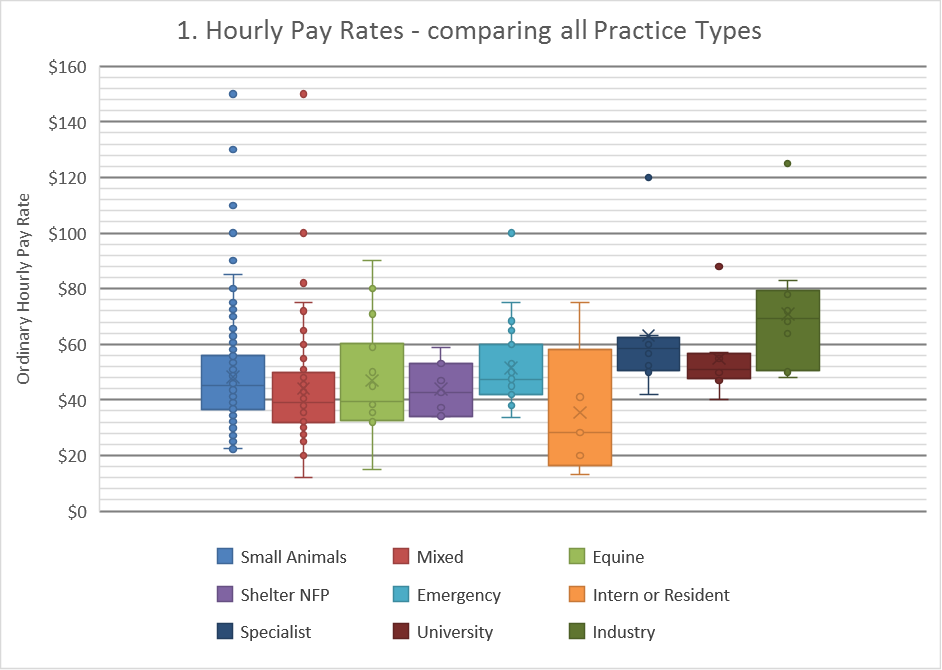
  1. Pay Rates compared by practice type, location, experience level, numbers of years graduated, corporate vs non-corporate, and by job classification (full time, part time, locums, and contractors)
  2. Gender Differences
  3. Out of Hours and Extras
  4. Happiness and Future Plans

Minimum pay rates and conditions are set in the Animal Care and Veterinary Services Award 2010, which you can find using Google, or at https://www.fwc.gov.au/documents/documents/modern_awards/award/ma000118/default.htm

Methodology

The pool of vets was contacted by direct emailing the main clinic email for all the clinics in Australia in the Kookaburra database (1,909 clinics), direct emailing all the vets currently registered as job seekers with Kookaburra ( approximately 143), and by including advertising banners with a direct link to the survey on the Australian pages of the websites www.kookaburravets.com and www.vetsuppliersdirectory.com.au , and on all the correspondence sent out from Kookaburra during the survey period. We also asked the HR departments of the major Australian corporates to assist by distributing the link to the survey to their veterinary associates. In addition, it was posted on Facebook on two of the Australian Veterinarian network closed group pages (briefly, as it was considered to be ‘advertising’ and was deleted by admin).

The survey was open from 15th July to 20th August 2019. It was hosted on Survey Monkey and analysis of results was carried out in Survey Monkey and using Microsoft Excel Office 365. The survey was anonymous, and no IP data was collected. There was a total of 16 questions.

For a Key to the box and whisker plots used, please see the Appendix at the bottom of this document

To download this Report as a printable pdf please click here
https://www.vetsuppliersdirectory.com.au/wp-content/uploads/2019/09/Survey-Results-2019-Part-1.pdf

Pay Rate All Practice Types

Pay vs Experience Level with scale

We wondered whether salary would be better correlated with another gauge of competence besides the numbers of years since graduation, so we asked respondents to self-assess their Technical Experience level according to the following scale, increasing in competence from 1 to 9, and then also including an option for non-clinical roles:

  1. Has broad theoretical knowledge, requires a more experienced vet to be available for discussion for consults/medicine, and guidance for surgery most of the time
  2. Confident for consults, requires guidance for surgery/procedures most of the time
  3. Confident for consults and routine surgery and seeks guidance for new procedures
  4. Confident for consults and routine surgery, able to work sole charge regularly
  5. Confident for consults, surgery, sole charge, and after hours emergencies
  6. Has or is working towards post graduate qualification in medicine, or other non-surgical qualification
  7. Has or is working towards post graduate qualification in surgery or ECC
  8. Has additional qualifications, supervises and teaches less experienced vets
  9. Has or is working towards specialist qualification
  1. Experienced in non-clinical / Industry roles


Years Graduated vs Experience Level with heading

Pay vs Experience Level

General Practice types vs years of experience with scale

Hourly Pay Histogram ft pt

Annualised Pay Histogram FT PT

Actual Pay Histogram FT PT

Hours Worked

Pay vs Hours worked with linear trend-line

Pay vs State2

Pay vs Location Category2

* Respondents gave the postcode for their current job. This was categorised according to the Australian Tax Office region and postcode definitions for the 2016-2017 tax year.

Locums

For data on Locums, we combined the data for vets classified as Casual with Self Employed Contractors. There was a total of 98 respondents in these 2 categories.

Locum Rates - vs Experience level

  1. Has broad theoretical knowledge, requires a more experienced vet to be available for discussion for consults/medicine, and guidance for surgery most of the time
  2. Confident for consults, requires guidance for surgery/procedures most of the time
  3. Confident for consults and routine surgery and seeks guidance for new procedures
  4. Confident for consults and routine surgery, able to work sole charge regularly
  5. Confident for consults, surgery, sole charge, and after hours emergencies
  6. Has or is working towards post graduate qualification in medicine, or other non-surgical qualification
  7. Has or is working towards post graduate qualification in surgery or ECC
  8. Has additional qualifications, supervises and teaches less experienced vets
  9. Has or is working towards specialist qualification
  10. Experienced in non-clinical / Industry roles


Locum Rates - Casual vs Contractor

Locum Rates - Corporate vs Non-Corporate1


Corporate Practices

Corporate vs non-corporate - small animal vs mixed practice1

Corporate Happiness

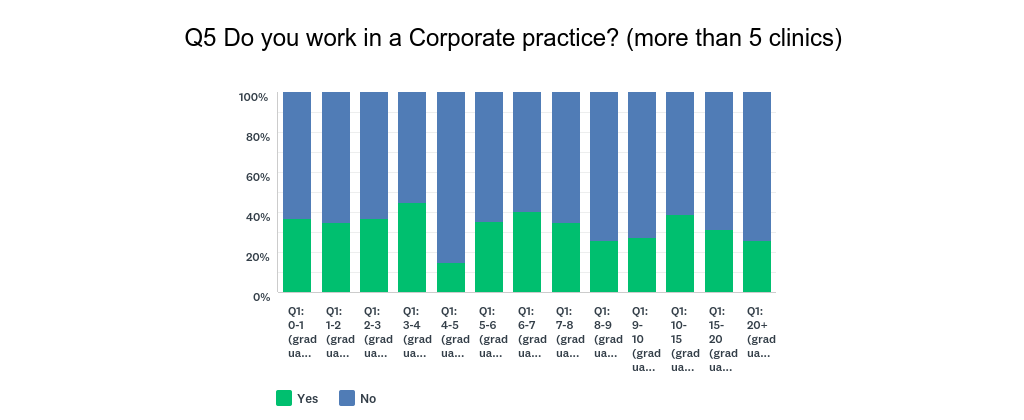
Corporate_practice_vs_year_graduated

Appendix

Key to Box Whisker plots

© Copyright Kookaburra Veterinary Employment

2nd September 2019

Logo

04/09/2019 |
© Vet Suppliers Directory 2019. Vantage Theme – Powered by WordPress.
Skip to toolbar